
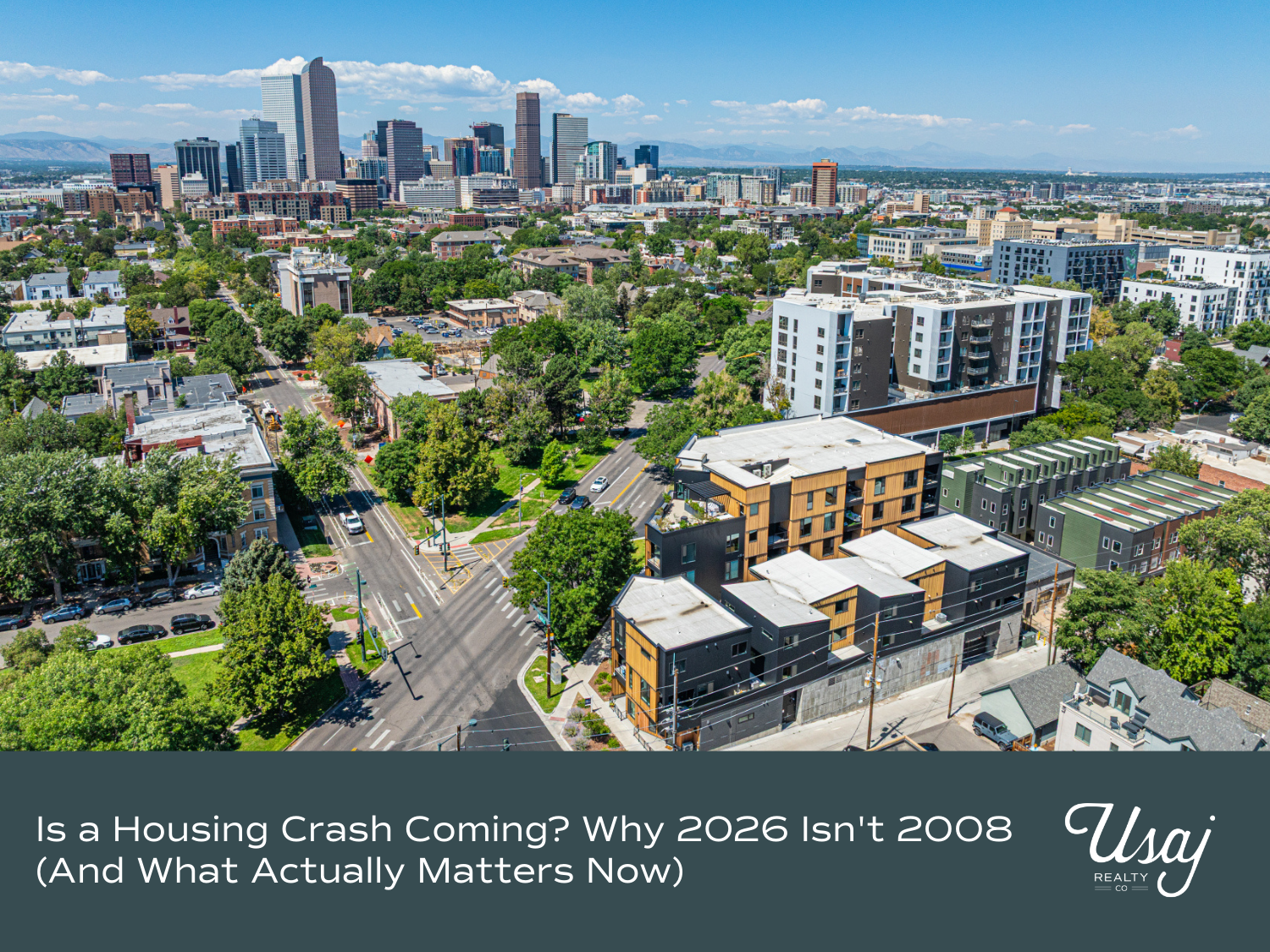
If you’ve been scrolling through real estate news lately, you’ve likely seen the “B-word” everywhere: Bubble.
With interest rates remaining “higher for longer” and home prices hovering near all-time highs, the “Anxiety Index” among buyers and sellers is at a fever pitch. National media outlets often capitalize on this fear, using “housing crash” headlines to drive clicks, leaving local Denver buyers terrified that they are buying at the absolute “top.”
But is 2026 really a repeat of 2008?
At Usaj Realty, we believe in replacing fear with facts. While the market is undeniably shifting, the fundamental “DNA” of today’s real estate environment is the polar opposite of the Great Recession. We aren’t looking at a collapse; we are looking at the Great Rebalancing.
Here is a data-backed look at why this market is built on a “Fortress” rather than a “House of Cards,” and what you actually need to watch for in the Denver housing market.
1. The Foundation: Lending Standards & Credit Quality
The 2008 crash was fueled by a systemic lack of documentation. “NINJA” loans (No Income, No Job, no Assets) were widespread, and subprime originations peaked at roughly 20% of the market.
Today, the market is protected by a regulatory wall. The Ability-to-Repay (ATR) and Qualified Mortgage (QM) rules ensure that every borrower is “stress-tested.”
2008 vs. 2026: At a Glance
| Metric | 2008 Market (Peak Bubble) | 2026 Market (Current Outlook) |
|---|---|---|
| Dominant Loan Type | Subprime, NINJA, No-Doc | Fully Documented, QM Loans |
| Median FICO Score | Often < 700 | 739 – 770 (Highly Prime) |
| Subprime Share | ~20% of originations | < 1% |
| DTI Standards | Flexible / Stated Income | Strict verification (capped at 43-45%) |
Current mortgage holders are the most creditworthy in U.S. history. We aren’t seeing the risky lending that preceded the previous crash; we are seeing a pool of buyers who can actually afford the homes they own.
2. The Equity Buffer: Why “Underwater” is a Rarity
In 2008, the trigger for the downward spiral was negative equity. When home values dipped, millions of people owed more than their homes were worth and simply walked away.
In 2026, homeowners are sitting on a record-breaking $11.5 trillion in tappable equity. Nearly 40% of U.S. homeowners own their properties outright, with no mortgage at all.
The “Equity Cushion”: Even if home prices were to dip by 10% nationally, the vast majority of owners still have massive “skin in the game.” This prevents the “forced selling” pipeline that causes a price spiral. Delinquency rates remain near historic lows because homeowners with equity can choose to sell traditionally rather than face foreclosure.
3. Supply vs. Demand: The Structural Deficit
The most significant difference between now and 2008 is inventory. In 2008, there was a massive oversupply of new construction. In 2026, we are still digging out of a decade-long housing shortage.
- The “Lock-In” Effect: Approximately 80% of current mortgage holders have rates below 5%. This has created “The Great Stay.” Sellers are unwilling to trade a 3% mortgage for a 6.5% rate, creating a natural “floor” for prices.
- Inventory Levels: Nationally, we see about 3.7 months of supply. In the Denver Metro area, active listings are 19.03% lower than they were in January 2008. We simply do not have enough houses to satisfy even a “softened” demand pool.
4. The “New” Headwinds: The Insurance Trigger
While interest rates get all the headlines, a new challenge has emerged in the Denver housing market forecast for 2026: ownership affordability.
We are currently navigating the “Insurance Trigger.” Rising property insurance premiums (up 74% nationally since 2008) and spiking HOA assessments are weighing heavily on the market. In Denver, some HOA master policies have increased by 200% to 500%, meaning a $400,000 condo might now come with a $600/month HOA fee.
Regional Divergence: This is where local strategy beats national panic. While “Pandemic Boomtowns” like Austin and Phoenix are seeing supply surges and price cuts, stable markets like Denver and Summit County remain resilient due to a more diversified economy and high lifestyle demand.
5. Risk Assessment: What Could Actually Cause a Correction?
To be the “calm expert,” we must also be honest about the risks. A housing crash requires people to have to sell.
The primary “Black Swan” to watch is unemployment. If the national unemployment rate spikes above the 6% threshold, the “Soft Landing” could become a “Hard Landing.” At that point, the equity cushion becomes secondary to the inability to service monthly debt. However, with the current labor market remaining tight, this remains a low-probability scenario for 2026.
Strategy: How to Navigate a “Softening” Market
For Buyers: The Lifestyle Trump Card
Waiting for a “crash” can be the most expensive mistake you make. While you wait for a 10% price drop that may never come, you lose out on equity build-up and continue to pay rising rents. In 2026, focus on time in the market, not timing the market.
For Sellers: The Equity Check-up
Concerned about how a market shift could impact your home’s value? Knowing your exact equity position is the first step in recession-proofing your portfolio.
[What Is My Home Worth? Use our real-time valuation tool here]
Conclusion: Facts Over Fear
2026 is a market of “selective buyers” and “stable sellers,” not a speculative bubble ready to burst. Real estate is, and always has been, a long-term game. Short-term volatility is normal, but the fundamentals of supply, credit quality, and equity remain the strongest they’ve been in decades.
Experience is gold when navigating uncertain markets. Don’t let national headlines dictate your local move.