
How the July 2018 Denver Market Compares to Today (2026)
Looking back at July 2018 provides a critical benchmark for understanding the Denver housing market’s long-term resilience. In July 2018, the median sales price for a single-family home was $450,000. As of March 2026, those who invested during that period have seen substantial equity growth, as Denver’s demand continues to outpace supply.
While 2018 buyers were navigating mortgage rates near 4.5%, the 2025-2026 market has seen a shift toward stabilization following the volatility of previous years. Furthermore, while the 7,643 active listings in July 2018 felt like a “tight” market then, it serves as a reminder of the inventory challenges that have defined the Colorado housing market for nearly a decade. Comparing these 2018 stats to our current 2026 forecast helps investors gauge the city’s impressive appreciation trajectory.
Inside the Denver Real Estate Market: July 2018 Trends
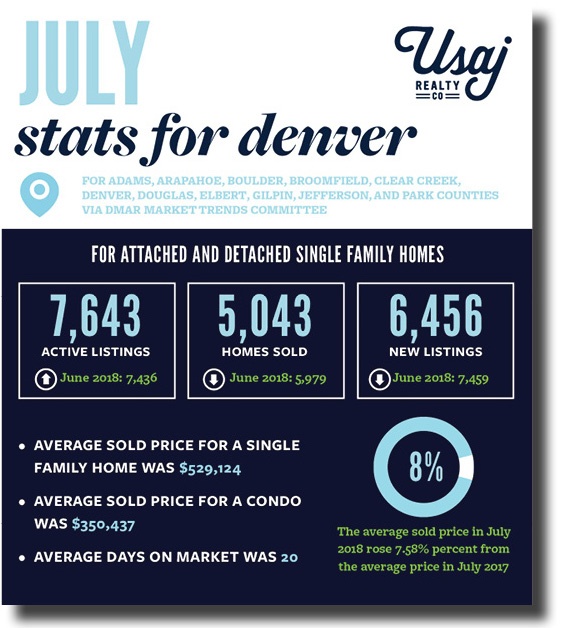
Inventory has slowly been ticking up each month of 2018, hopefully helping Denver buyers to stay motivated and encouraged when house hunting. Highest average sold prices so far in 2018 was in April for single-family (coming in at $540,105) and June for condos (coming in at $360,702). July did see a dip in these numbers, which has been typical for this time of year due to school starting back up. Fear of rising interest rates could also be a contributing factor. Mortgage rates did see their highest level in 2 months this week, after they had been in decline since mid-June due to fears of a trade war (SLT, CNBC).
According to Freddie Mac mortgage rates had stepped back in mid-June due to declining long-term Treasury yield, which were affected by a trade war. However, “some of those tensions were eased last Wednesday when President Trump and European Commission President Juncker struck a deal to avert a trade war” and mortgage rates returned to their higher numbers reached in early June (Zillow).
Fewer homes sold and a slight increase in inventory could also be due to historically high prices of homes in the metro area, leaving less people able to afford to purchase property. However, when compared to other markets, Denver’s 3.96 percent increase in inventory year-over-year in July 2018 doesn’t come close: “According to Realtor.com, active listings in July were up 44 percent year-over-year in San Jose, 29 percent in Seattle, 19 percent in Portland, 18 percent in San Diego, and 15 percent in Dallas,” (Curbed).
Denver Real Estate Resources & Tools
- Stay Updated: View our Current Denver Housing Market Trends & Forecast.
- Local Expertise: Connect with an experienced Denver Real Estate Agent.
- Explore Areas: Browse our Denver Neighborhood Guides to find your perfect community.
- Home Valuation: Curious what your home is worth after 8 years of appreciation? Get a Free Valuation.
- Denver Real Estate Market Report 2018
- June 2018 Denver Housing Market Report
- August 2018 Denver Housing Market Report