

Historical Report: This post reflects Denver housing market data and trends from August 2019. Looking for current 2026 data? Visit our Latest Denver Real Estate Market Report for the most up-to-date statistics and analysis.
Originally Published: September 2019 | Updated for Historical Context: March 8, 2026
How the August 2019 Denver Market Compares to Today (2026)
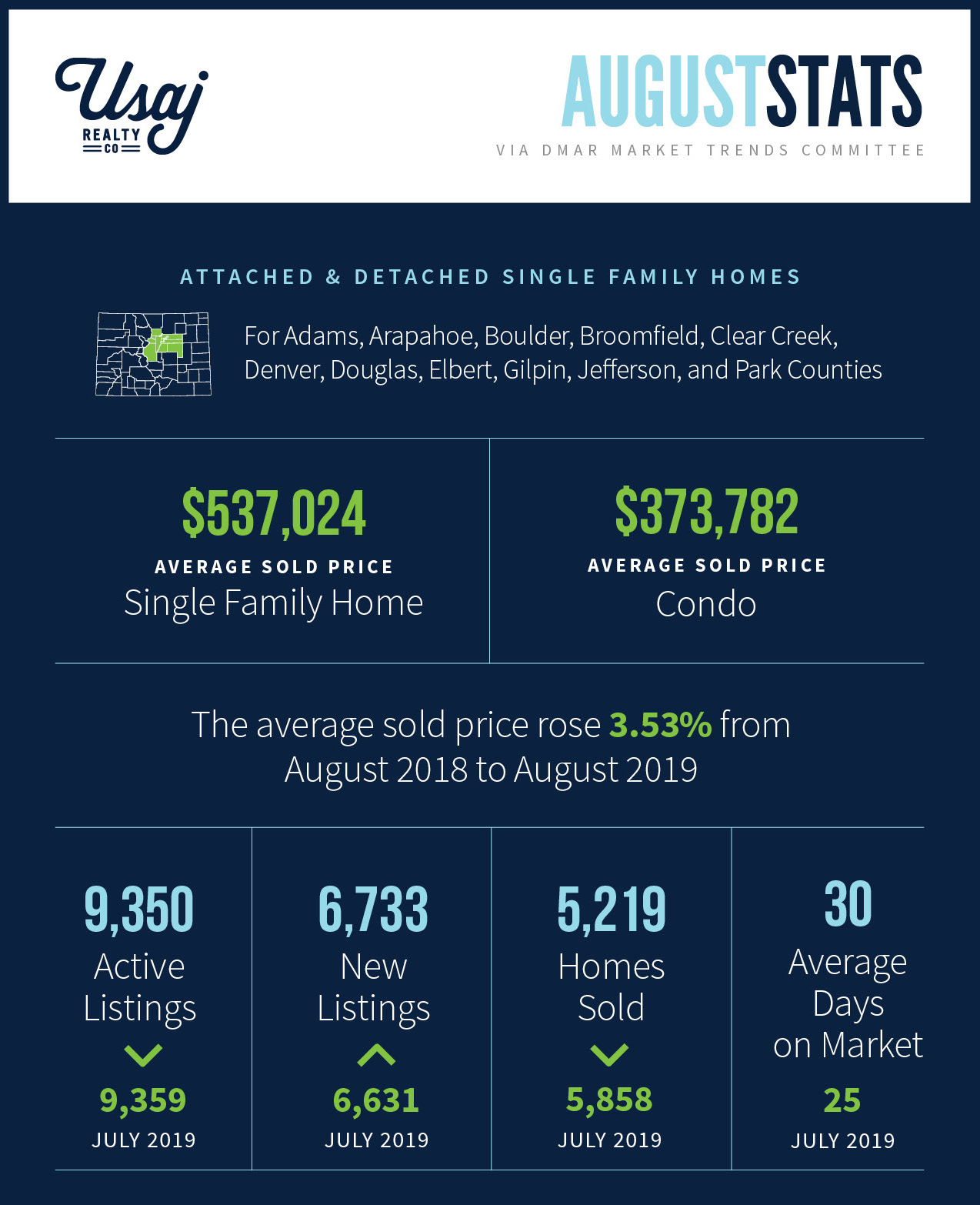
Reflecting on August 2019 provides a fascinating look at the evolution of the Denver metro market. At that time, the median sold price was $425,000—a figure that served as a launchpad for the historic appreciation we’ve seen over the last several years.
- Price Growth: Since 2019, Denver has experienced a historic surge in equity. While the 2019 single-family price point was $459,900, today’s 2026 valuations reflect a significantly more mature and expensive market.
- Inventory Shifts: In August 2019, there were 9,350 active listings. While this was considered “low inventory” pre-pandemic, it represents a much more balanced market than the extreme inventory droughts experienced in the early 2020s.
- Mortgage Rates: This 2019 report highlights rates in the 4-5% range. Looking back from 2026, these rates remind us of the “pre-pandemic” era before the volatility of the mid-2020s shifted buyer purchasing power.
Curious about your current home value? Contact a Usaj Realty broker for a modern comparative market analysis.
Denver Real Estate Inventory Levels (August 2019)
- Active Inventory in August 2019: 9,350
- July 2019: 9,359
- June 2019: 9,520
- May 2019: 8,891
- April 2019: 7,012
- March 2019: 6,292
- February 2019: 6,017
- January 2019: 5,881
- December 2018: 5,577
- November 2018: 7,530
- October 2018: 8,539
- September 2018: 8,807
- August 2018: 8,228
- July 2018: 7,643
- June 2018: 7,436
- May 2018: 6,437
- April 2018: 5,160
- March 2018: 4,619
- February 2018: 4,084
- January 2018: 3,869
- December 2017: 3,854
- November 2017: 5,131
- October 2017: 6,312
- September 2017: 7,586
- August 2017: 7,360
Market Performance for the Denver Metro Area
Historical Real Estate News: What Impacted Denver in 2019
More days on market and price drops, but Denver housing market still favors sellers
“It now takes nearly a month on average to sell a home in metro Denver and practically every new listing is followed by a price reduction.” – Denver Business Journal
New home construction keeps falling in metro Denver
“For the first time since the depths of the housing crash in 2009, the pace of new home construction in metro Denver has dropped for three consecutive quarters. The number of construction starts on new homes dropped 10.5 percent in the second quarter compared to the same period a year ago. That was mostly driven by a steep 17.6 percent drop in single-family home starts, according to counts maintained by Metrostudy, which tracks new home construction across the country.” – Denver Post
Increasing demand from renters for larger units
“As homeownership in Denver becomes increasingly more expensive, we expect demand for larger rental units to increase. This shift is likely to be driven by demographics and the overall cost of housing. In the Western United States, homeownership rates peaked at just under 65% in 2006. The homeownership rate declined significantly in the years following the Great Recession.” – CREJ
In the News: What’s Happening Nationally + Internationally
Banks are paying people to borrow money. That’s alarming news for the global economy.
“For Americans accustomed to paying 4 or 5 percent mortgage rates, let alone the double-digit figures consumers endured in the early 1980s, the new loan from Denmark’s Jyske Bank might seem inconceivable. The Danish lender last week started offering home buyers 10-year mortgages at an interest rate of -0.5 percent. That means borrowers over a decade will pay back a little less than the amount borrowed, not including one-time fees.” – The Washington Post
US 30-year bond yield falls to record low under 2% as global recession fears grow
“Traders across the board have pointed to a deterioration in U.S.-China trade relations as the catalyst for August’s dramatic stock and bond moves, including a 60-basis-point drop in the 10-year Treasury rate. But notwithstanding the latest barbs between the world two largest economies, Treasury demand remains strong and likely symptomatic of traders’ belief in a larger, more malignant downturn in the global economy and a secular decline in inflation.” – CNBC
Why aren’t more Millennials buying homes? A bunch don’t understand mortgages
“While the number of Millennial homeowners is rapidly increasing, a recent survey from LendEDU showed that 42% have yet to buy a house. In the survey that was taken by 1,000 people between the ages of 23 and 38, almost 90% of the non-homeowners responded that they aspire to homeownership. When asked how many years they were away from that goal, the largest portion, 65%, estimated it would be one to five years before they were homeowners. Their biggest reason for the delay: finances.” – HousingWire
Trump’s China tariffs are already hitting the housing industry
“As the administration continues to discuss levying new tariffs as part of its ongoing dispute with China, the escalating trade war is already touching many of the raw materials the housing industry depends on; the current 25 percent tariff on imported building material that went in effect in May has been called a “$2.5 billion tax on housing” by the National Association of Home Builders.” – Curbed
Is a recession coming? Here’s what that means for housing
“The short term impact to housing is less likely to be as reactive,” Javier Vivas, director of economic research at Realtor.com, says. “The impact of the last recession is fresh in our minds and can have a play in home buyer psychology. But barring weak fundamentals, housing tends to perform fairly well during recessions. Over-construction is largely what got us into trouble last recession, and we’ve experienced just the opposite since then.” – Curbed
Thinking of selling in 2026?
Compare your home’s 2019 value to today’s market prices.